Latest stories
Story · 1 report
Anthropic's internal AI use, at retail prices, now exceeds its employee pay
Anthropic disclosed in its IPO filing that the retail value of Claude AI used internally exceeded its monthly employee compensation costs, excluding stock awards, in April. The figure values internal Claude consumption at the prices Anthropic charges customers rather than representing cash spending on AI. Internal AI usage, measured on that basis, rose more than 250-fold between January and September. Claude generated more than 90% of the code added to Anthropic’s software in September, according to the filing. Anthropic’s revenue has also grown much faster than its headcount. The company’s internal-use figures illustrate how AI tokens, a measure of model usage, are increasingly being considered alongside salary, bonuses, and stock awards when assessing the resources used by technology companies and their employees.
businessinsider.com
🔥🔥🔥🔥🔥1 min summary
4d ago
Story · 1 report
Jobless tech workers are being left out of San Francisco's AI boom
Anthropic and OpenAI’s anticipated initial public offerings are expected to create substantial wealth in San Francisco, while layoffs and an uncertain technology job market continue to affect workers in the region. The contrast was visible across the Golden Gate Bridge at a Monday gathering of more than four dozen laid-off technology workers. The group met at 11 a.m. to hike Mount Tamalpais, a peak overlooking San Francisco Bay. Participants descended a mostly deserted trail in groups of roughly a dozen, led by former Google employee Basem Istanbouli, who wore a bucket hat and toe shoes. The gathering reflected the gap between the AI sector’s projected financial gains and joblessness among some technology workers.
bloomberg.com
🔥🔥🔥🔥🔥1 min summary
4d ago
Story · 1 report
Anthropic reports $17B in Q3 revenue, commitments of $895B in revised S-1
Anthropic disclosed updated third-quarter financial results and infrastructure commitments in an amended Form S-1 filed with the U.S. Securities and Exchange Commission. The company generated roughly $17 billion in third-quarter revenue, up about 1,127% year over year, and $33.24 billion during the nine months ended September 30, roughly 1,200% higher than a year earlier. Third-quarter revenue grew about 47% from the prior quarter, compared with 144% growth in the second quarter and 132% in the first quarter. Anthropic reported a third-quarter net loss of $23.29 billion and a nine-month net loss of $104 billion; it said most of the nine-month loss stemmed from changes in the fair value of convertible notes and derivative liabilities. Anthropic has entered purchase commitments and lease agreements totaling about $895.4 billion, substantially all for compute and infrastructure. Compute and infrastructure expenses increased by $14.4 billion in the first nine months of the year, a 329% increase from the same period last year. The five-year-old Claude developer is preparing for a potential initial public offering after publishing its prospectus last week. Its filing identifies political, infrastructure, safety and commercial risks, while its co-founders said they view mitigating risks from AI models as a personal responsibility.
cnbc.com
🔥🔥🔥🔥🔥1 min summary
4d ago
Story · 1 report
Last night an AI agent performed brain surgery on a mouse
Gabriel Ocana-Santero said an AI agent performed brain surgery on a mouse overnight in an experiment intended to reduce seizures in a mouse model of epilepsy. The agent received a spreadsheet containing 19 gene-therapy vectors, access to a motorized surgical rig with cameras, and a goal of reducing seizures. According to Ocana-Santero, the agent selected a drug and a target brain region, then derived surgical coordinates from three papers. It used stereotaxic arms to enter the brain and inject 250 nanolitres, while monitoring the entry site through the rig’s camera for bleeding. A licensed veterinarian approved every irreversible step and retained a physical kill switch to halt the agent. Ocana-Santero also said the agent at one point refused an attempted override, without providing further details in the post.
twitter.com
🔥🔥🔥🔥🔥1 min summary
4d ago
Story · 1 report
China's First Frontier AI Export Controls: Mofcom Announcement No. 48
China’s Ministry of Commerce and Ministry of Science and Technology issued Announcement No. 48 on October 16, 2026, proposing export controls on 40 technologies, including 23 AI technologies. The draft catalogue is open for comment until November 15, while an interim requirement to register covered technology exports before shipment took effect immediately, including for exports already underway. Prohibited technologies cannot be exported, while restricted technologies require licenses. The proposed controls cover frontier-model weights, checkpoints, source code, architectures, training and inference optimization know-how, advanced agents, AI cyber tools, chips and compute clusters. Model technology would be restricted if it meets any one of three tests: training compute of at least 10^26 FLOPs, at least 2 trillion parameters, or a top-10 global position in public evaluations, call volume, or comparable measures at export time. High-performance agents designed mainly for critical infrastructure, defense, or core government use would be prohibited. MOFCOM says API access, websites, SaaS and lightweight on-device use are not large-model exports, but local deployment of a restricted model outside China is within export management. Registration can also be triggered by overseas licensing and ownership or control changes involving foreign entities. Technologies already made public through open-source releases or academic publications are excluded, while newly open-sourced restricted technologies may receive automatic licensing after reporting.
labs.cloudsecurityalliance.org
🔥🔥🔥🔥🔥2 min summary
4d ago
Story · 1 report
AI fan wikis riddled with errors are muddying the waters of games culture
AI-generated and AI-assisted game wiki sites are appearing in search results for smaller games, sometimes outranking fan-maintained resources while publishing false or irrelevant information. A site calling itself the Nighthawks Wiki listed nonexistent companions and skills and mixed in material about the 1981 film and Edward Hopper painting; it was not openly editable and directed corrections by email. Its domain was registered through Spaceship, which offers an AI website builder, but its operators could not be reached for comment. Hooded Horse CEO Tim Bender says the publisher has had to compete with inaccurate AI-generated sites in search results for its games, including a Corsair Cove page operated by GameDB. GameDB’s creator acknowledged using generative AI for a collection spanning more than 20 games. Bender says low production costs let commercial operators create enough pages to capture even limited advertising traffic, while misleading players seeking game help. Volunteer-run independent wikis also face infrastructure costs from AI crawlers. The Dune: Awakening Community Wiki recorded 7 million crawler requests in 30 days, including 5 million from Meta, according to publicly available internal data cited by maintainer FlamingMojo. He says AI-related traffic has contributed to server costs rising three- to ten-fold and argues that community participation and shared ownership are necessary to sustain reliable wikis.
eurogamer.net
🔥🔥🔥🔥🔥2 min summary
4d ago
Story · 1 report
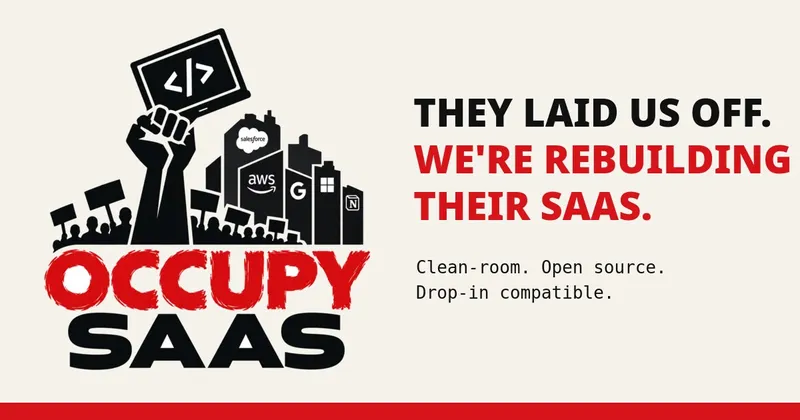
OccupySaaS
OccupySaaS is an open-source movement building clean-room, self-hostable replacements for subscription software using public documentation, open standards and compatibility testing against vendors’ public SDKs. It says laid-off engineers and AI agents can recreate widely used SaaS APIs without proprietary code, leaked information, decompiled binaries, copied UI assets or trademarks. Projects publish CLEAN_ROOM.md policies and record the provenance of fixtures and references; humans write specifications and review code changes. The first two projects are ZeroAuthy, an identity server intended to work with Auth0 client SDKs without application code changes, and SalesCompel, a Salesforce-compatible CRM under development. ZeroAuthy supports OIDC discovery, JWKS, multi-tenant domains, hosted login, authorization-code flow with PKCE, client credentials, rotating refresh tokens, revocation and logout. It has been tested with auth0-spa-js, auth0-react and nextjs-auth0. SalesCompel has a Go and PostgreSQL backend, a Vue record editor, Account and Contact CRUD, limited queries, external-ID upserts, bearer authentication and an OpenAPI 3.2 REST contract. Both projects are early and not production-ready. They are released under Apache License 2.0, with no required telemetry or seat-based pricing. OccupySaaS says it is independent of Auth0, Okta and Salesforce, and plans to consider further targets including documentation, issue tracking, feature flags, observability and customer support software.
occupysaas.com
🔥🔥🔥🔥🔥1 min summary
4d ago
Story · 1 report
So I guess everyone uses LLMs to think now
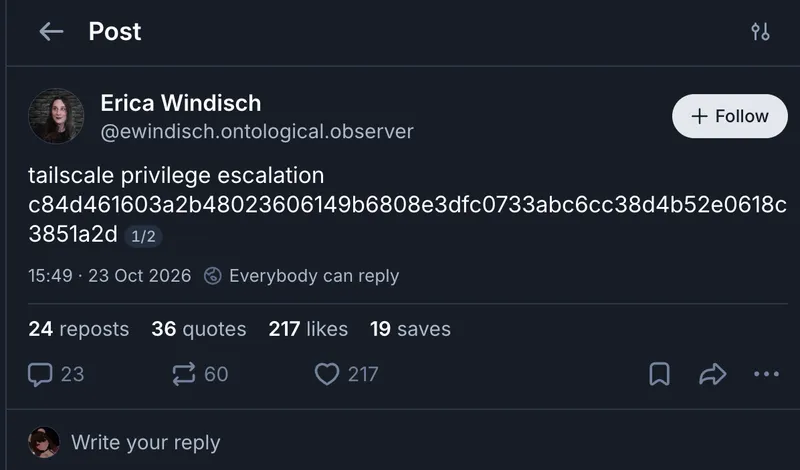
Eva, a security researcher and blogger, says she has never used AI for research published on her site and prefers manual coding, debugging, reverse engineering, source-code exploration, and vulnerability research. She says LLM output can be confidently wrong and frustrating to supervise, while acknowledging that the models are powerful. Eva argues that current LLMs still require skilled human guidance; she says an unguided model would probably not find a Linux kernel remote-code-execution vulnerability on its own. Eva criticizes AI companies’ cybersecurity marketing, citing differing accounts of the php2shell research collaboration involving Calif, OpenAI, and Wiz. She says OpenAI emphasized an agent uncovering critical vulnerabilities, while Calif described human-guided AI research. Eva also argues that publishing proof-of-concept videos, product-linked hashes, or cryptic vulnerability announcements before patches are available can create unnecessary risk and panic. She cites a publicly disclosed Tailscale SSH privilege-escalation issue that she says required existing ACL access to a machine with Tailscale SSH enabled, and alleges it was not responsibly disclosed to Tailscale before publication. Eva contrasts AI-assisted findings with the eMudhra certificate-authority private-key incident, which she says a human discovered using Google’s paranoid_crypto library. She argues that personal projects provide learning and enjoyment that AI-generated work can reduce.
eva.ac
🔥🔥🔥🔥🔥2 min summary
4d ago
Story · 1 report
It wasn't AI that flipped Proton's charge
Proton CEO Andy Yen reportedly told an engineer that requesting several days to penetration-test new code before release was “bullshit and loser thinking,” while urging staff to stop “lovingly handcrafting code” and use AI more. The reported exchange occurred in Proton’s security Slack channel and followed leadership’s push to expand AI use inside the privacy-focused company. The criticism centers on Proton’s leadership and software-release practices rather than on AI-generated code itself. AI coding tools can be used with review, testing, and clear accountability for production releases. Proton’s products depend on user confidence that security-sensitive software, including email services, is developed and tested carefully; a flaw exposing user mail could seriously damage that trust. Staff were reportedly told that their AI use could affect whether they retained their jobs. After that plan was dropped following a leak, Yen reportedly said it had already served its purpose. A Proton employee writing on Reddit said Yen supported penetration testing provided it did not slow the release pipeline. The reported events have raised questions about whether Proton can maintain security testing standards while leadership prioritizes release speed and AI adoption.
blog.raed.dev
🔥🔥🔥🔥🔥1 min summary
5d ago
Story · 1 report
Nurses Sound Alarm as 'Uber for Nursing' Apps Push to Deregulate Healthcare
The AI Now Institute’s April 21, 2026 report, Uber for Nursing Part II, says gig staffing platforms including Clipboard Health, ShiftKey, CareRev and IntelyCare are lobbying state governments to exempt their businesses from rules governing traditional healthcare staffing agencies. Since 2022, lawmakers in at least 17 states have introduced related bills, the institute says. New York instead classified gig nursing platforms as healthcare staffing agencies in 2025; the report says Clipboard Health, Nursa and KARE then stopped operating in the state. The report says these apps use algorithmic pricing, nurse ratings and shift-bidding systems to fill hospital and long-term-care shifts. CareRev’s Smart Rates system recommends hourly rates using market demand and past performance, according to the institute, while some Quick Bid systems award shifts to the lowest bidder. A companion Roosevelt Institute brief found that some platforms use data-broker information on nurses’ debt levels to offer lower pay to workers with higher debt. The AI Now Institute says contractor classification can deny nurses benefits and workplace protections, while cancellations, ratings and a lack of paid orientation can affect work opportunities and safety. The ten largest gig-nursing platforms have raised about $1.4 billion, the report says, including ShiftKey’s reported $2 billion valuation and Clipboard Health’s $1.3 billion valuation.
nurse.org
🔥🔥🔥🔥🔥2 min summary
5d ago